
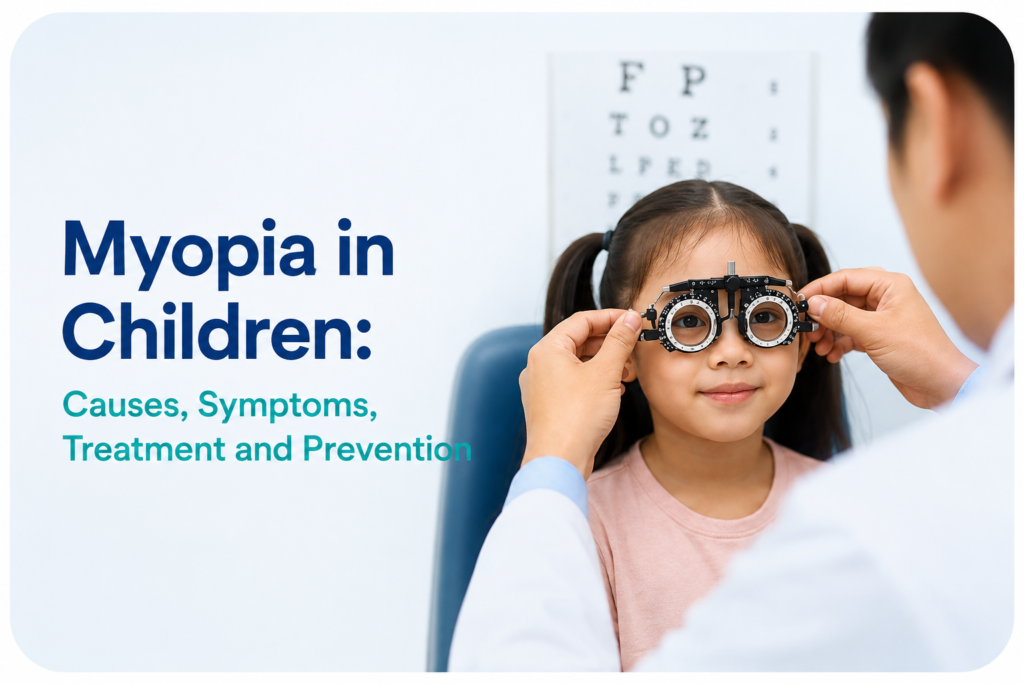
Myopia in children, commonly called short-sightedness or nearsightedness, is a common eye condition in which distant objects appear blurred while nearby objects are usually clearer. A child may be able to read a book but struggle to see the classroom board, television or objects at a distance.
Childhood myopia can develop as the eyes grow and may increase during the school years and teenage years. Because children may not always recognise that their vision is blurry, parents may notice the problem through changes in behaviour, school performance or visual habits.
If you are looking for a Paediatric Eye Specialist in Dhule, understanding the early signs, causes and treatment options for myopia can help you seek appropriate eye care at the right time.
What Is Myopia in Children?
Myopia is a refractive error in which light entering the eye focuses in front of the retina instead of directly on the retina. This makes distant objects look blurred.
A child with myopia may:
- See a book clearly from close range
- Have difficulty seeing the classroom board
- Squint to see distant objects
- Sit closer to the television
- Move closer to objects to see them clearly
Myopia often changes as a child’s eyes continue to develop. Regular eye examinations can help monitor the child’s vision and spectacle prescription.
What Causes Myopia in Children?
Myopia does not have one single cause. Genetics, eye growth and environmental factors can all contribute.
Family History
Children with one or both parents who have myopia are more likely to develop it. A family history of short-sightedness is therefore an important factor when assessing a child’s risk.
Eye Growth
Childhood myopia is commonly related to the length and development of the eye. As the eye grows, the way light focuses on the retina can change.
Near Work
Reading, studying and using digital devices require children to spend time focusing on nearby objects. A high amount of near work may be associated with myopia risk, although the relationship is complex.
Less Outdoor Time
Children who spend more time outdoors have been found to have a lower risk of developing myopia. Outdoor activity is therefore an important part of healthy visual habits.
What Are the Symptoms of Myopia in Children?
Children may not tell their parents that they cannot see clearly. Parents should watch for signs such as:
- Difficulty seeing the classroom board
- Squinting when looking at distant objects
- Sitting very close to the television
- Holding books or screens close to the face
- Frequent eye rubbing
- Complaints of headaches during visual activities
- Difficulty recognising people from a distance
- Avoiding sports or activities that require distance vision
- Difficulty copying information from the classroom board
- Declining school performance related to difficulty seeing
If these signs are persistent, an eye examination can help determine whether myopia or another vision problem is present.
How Can Parents Recognise Myopia Early?
Some children adapt to blurred distance vision without complaining. They may simply sit closer to the board or television or rely on squinting to see distant objects.
Parents can observe their child’s daily visual behaviour and ask simple questions such as:
- Can you see what is written on the board?
- Can you see the television clearly from your usual seat?
- Can you recognise people from a distance?
- Do your eyes feel tired after studying?
If a child frequently struggles with distance vision, professional assessment is recommended.
How Is Myopia Diagnosed in Children?
A Paediatric Eye Specialist can perform a comprehensive eye examination suitable for the child’s age.
The examination may include:
- Distance vision testing
- Near vision testing
- Refraction
- Eye alignment assessment
- Eye movement evaluation
- Examination of the eye
- Additional tests when required
In children, accurate measurement of refractive error is particularly important. Cycloplegic refraction is considered the standard approach for accurately determining refractive error in children because children can accommodate strongly during testing.
What Is the Treatment for Myopia in Children?
The treatment plan depends on the child’s age, degree of myopia, rate of progression and overall eye health.
1. Prescription Glasses
Prescription glasses are commonly used to correct myopia in children. The appropriate lens prescription helps focus light correctly on the retina and improves distance vision.
Children should wear their prescribed glasses according to the advice of their eye specialist.
2. Contact Lenses
Contact lenses may be considered for selected older children or teenagers who can safely manage lens hygiene and care.
The decision depends on the child’s maturity, eye health and individual needs.
3. Myopia Management
If myopia is progressing, the eye specialist may discuss myopia management.
Depending on the child, options may include specialised spectacle or contact lenses and certain low-dose atropine treatments. The choice of treatment should be based on an individual clinical assessment.
4. Regular Eye Examinations
Children with myopia need appropriate follow-up to monitor changes in their prescription and, when indicated, other measurements related to eye growth.
AAPOS notes that many children with myopia should have yearly eye examinations, while children receiving treatment to slow progression may require more frequent follow-up.
Can Myopia in Children Be Controlled?
In some children, the progression of myopia can be slowed with appropriate myopia-management strategies.
The goal of myopia control in children is not simply to make the child see clearly with glasses. It is also to manage the progression of myopia when clinically appropriate.
Depending on the child, an ophthalmologist may consider:
- Specialised spectacle lenses
- Specialised contact lenses
- Low-dose atropine
- Orthokeratology in selected cases
- Increased outdoor activity
- Regular monitoring
Not every treatment is suitable for every child. A Paediatric Eye Specialist in Dhule can assess the child’s individual condition and recommend an appropriate approach.
Does Screen Time Cause Myopia in Children?
Screen use is an important concern for many parents. However, it is better to look at the child’s overall visual habits rather than assume that screens alone cause myopia.
Long periods of near work and reduced outdoor time may be associated with myopia risk. Parents can encourage healthier habits by:
- Keeping screens at a comfortable distance
- Taking regular breaks from near work
- Avoiding unnecessary close viewing
- Encouraging outdoor activities
- Maintaining good lighting
- Following the child’s prescribed eye-care plan
AAPOS recommends practical habits such as keeping reading and screens at least 12 inches away and using the 20-20-20 rule: every 20 minutes, look about 20 feet away for 20 seconds.
Can Outdoor Time Help With Childhood Myopia?
Yes, regular outdoor activity is an important healthy habit for children and is associated with a lower risk of developing myopia.
Encouraging children to spend time outdoors can help balance long periods of studying and near activities. Outdoor activity should be part of an overall healthy routine and does not replace professional eye examinations or prescribed myopia treatment.
Can Myopia in Children Be Prevented?
Not every case of myopia can be prevented because genetic factors also play a role.
However, parents can encourage healthy visual habits such as:
- Spending regular time outdoors
- Taking breaks during prolonged near work
- Maintaining a comfortable reading distance
- Avoiding unnecessarily close screen viewing
- Following recommended eye examinations
- Seeking professional advice when vision changes are noticed
Early identification is important because interventions to delay myopia onset or reduce progression are increasingly available.
Myopia and Squint: Are They the Same?
No. Myopia and squint are different eye conditions.
Myopia affects the clarity of distance vision, while squint, also called strabismus, refers to an abnormal alignment of the eyes.
A child can have myopia and squint at the same time. This is why children with concerns about both vision and eye alignment may benefit from assessment by a Paediatric and Squint Eye Specialist.
When Should You Take Your Child to a Paediatric Eye Specialist in Dhule?
Parents should consider an eye examination if their child:
- Cannot see the classroom board clearly
- Frequently squints
- Sits very close to the television
- Complains of blurred distance vision
- Frequently rubs the eyes
- Has headaches during reading or studying
- Holds books or devices unusually close
- Has difficulty with schoolwork because of poor distance vision
- Has an eye that turns in or out
- Has rapidly changing spectacle power
Children may not always recognise a vision problem themselves. Periodic vision screening and appropriate eye examinations can help identify problems earlier.
Why Choose a Paediatric and Squint Eye Specialist?
Children’s eyes are still developing, and their vision-care needs can differ from those of adults.
A Paediatric and Squint Eye Specialist in Dhule can evaluate children’s:
- Vision
- Refractive errors
- Eye alignment
- Eye movements
- Lazy eye
- Myopia
- Squint
- Other childhood eye conditions
A detailed examination can help identify the underlying problem and guide parents regarding suitable treatment and follow-up.
Dr. Vrushali Patil – Paediatric Eye Specialist in Dhule
For parents looking for a Paediatric Eye Specialist in Dhule, Dr. Vrushali Patil – Paediatric and Squint Eye Specialist can help evaluate children’s vision and eye-alignment concerns.
Childre n with suspected myopia, changing spectacle power, squint or other visual concerns can undergo an age-appropriate eye examination to understand their eye health and vision needs.
The recommended treatment should always be personalised according to the child’s age, eye condition, visual requirements and rate of myopia progression.
Frequently Asked Questions
1. What is myopia in children?
Myopia is a refractive error in which distant objects appear blurred while nearby objects are usually seen more clearly.
2. What are the symptoms of myopia in children?
Common symptoms include difficulty seeing the classroom board, squinting, sitting close to the television, holding books close to the face and blurred distance vision.
3. What causes childhood myopia?
Genetics, eye growth, near-work habits and limited outdoor time can contribute to the development of childhood myopia.
4. Can myopia in children get worse?
Yes. Myopia commonly progresses during childhood and teenage years as the eyes continue to grow.
5. How is myopia treated in children?
Prescription glasses are commonly used. Depending on the child’s condition, contact lenses or myopia-management options may also be considered.
6. Can myopia progression be slowed?
In selected children, myopia-management treatments may help slow progression. An ophthalmologist can determine whether a particular treatment is appropriate.
7. Does screen time increase myopia risk?
The relationship is complex. Long periods of near work and limited outdoor time may be associated with myopia risk, so healthy screen habits and outdoor activity are encouraged.
8. How much outdoor time should children get?
AAPOS recommends that children spend meaningful time outdoors and its patient guidance suggests at least one hour daily; another AAPOS resource recommends aiming for around two hours per day. The appropriate routine can vary by child and circumstances.
9. Is myopia the same as squint?
No. Myopia affects vision clarity, while squint affects eye alignment. A child can have both conditions.
10. When should I consult a Paediatric Eye Specialist in Dhule?
If your child has blurred distance vision, difficulty seeing the classroom board, frequent squinting, headaches during visual activities or an abnormal eye turn, an eye examination can help identify the cause.
Conclusion
Myopia in children should not be ignored, especially when a child has difficulty seeing distant objects or shows changes in visual behaviour. Early examination can identify myopia and help monitor changes as the child’s eyes develop.
Depending on the child’s individual needs, management may include prescription glasses, contact lenses, outdoor activity, healthy visual habits or specific myopia-management treatments.
If you are searching for a Paediatric Eye Specialist in Dhule, consulting Dr. Vrushali Patil – Paediatric and Squint Eye Specialist can help you understand your child’s vision and receive appropriate guidance for ongoing eye care.