
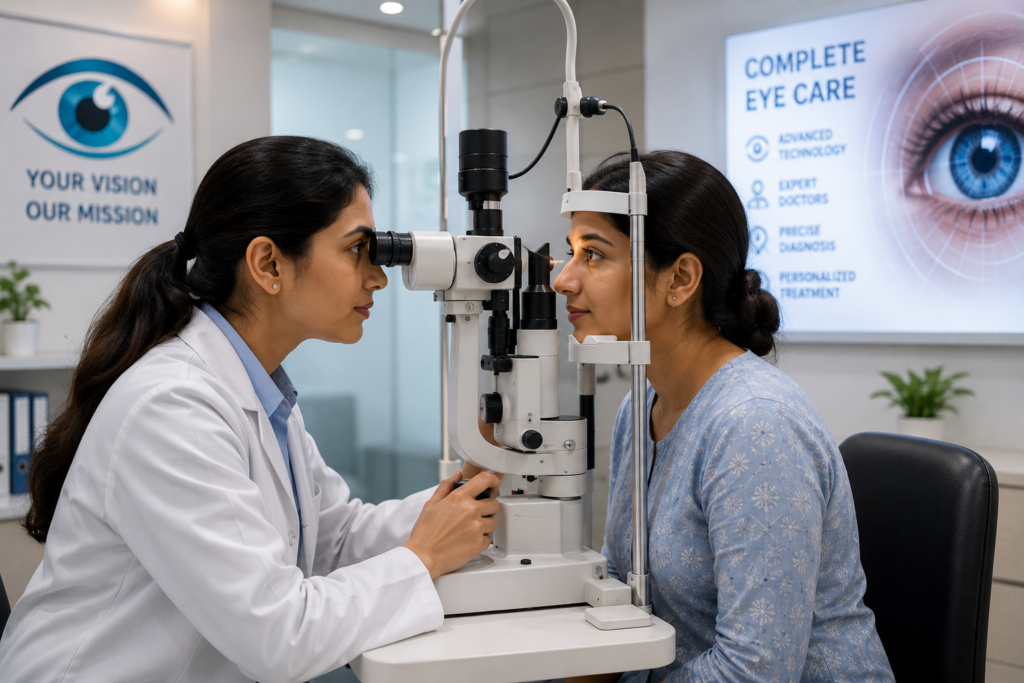
Choosing the right eye hospital is an important decision for you and your family. Whether you need a routine eye check-up, cataract treatment, cornea care, LASIK evaluation, or specialised children’s eye care, the quality of diagnosis and treatment matters.
If you are searching for the best eye hospital in Dhule, it is better to look beyond online rankings. The ophthalmologist’s experience, available services, diagnostic facilities, treatment options, technology, transparency and follow-up care can all help you make a more informed decision.
What Should You Look for in an Eye Hospital?
The right eye hospital depends on your individual eye condition and treatment needs. A centre providing comprehensive eye care should ideally offer:
- Experienced ophthalmologists
- Comprehensive eye examinations
- Appropriate diagnostic facilities
- Cataract and Phaco care
- Cornea evaluation
- LASIK assessment
- Laser vision correction
- Children’s eye care
- Squint evaluation
- Post-treatment follow-up
Here are 10 important things to consider when choosing an eye hospital in Dhule.
1. Check the Ophthalmologist's Qualifications and Experience
The doctor’s qualifications and clinical experience are among the most important factors to consider.
Different eye conditions may require different areas of expertise. For example, cataract surgery, corneal conditions, refractive errors and children’s eye problems may require different types of evaluation.
At Shri Ramchandra Netralaya, Dr. Saket Patil, Cornea, LASIK and Phaco Expert, provides specialised care related to cornea, laser vision correction and cataract procedures.
When choosing an eye specialist in Dhule, consider:
- Qualifications and training
- Relevant clinical experience
- Area of specialisation
- Experience with your particular condition
- Ability to explain treatment options
- Availability of follow-up care
A consultation should give you an opportunity to understand your diagnosis and the treatment options suitable for your eyes.“
2. Look at the Range of Eye-Care Services
Eye problems can range from simple refractive errors to conditions that require medical or surgical treatment.
When comparing an eye hospital in Dhule, check whether it offers services relevant to your needs, such as:
- Comprehensive eye examinations
- Cataract evaluation and surgery
- Phaco surgery
- Cornea care
- LASIK evaluation
- Laser eye procedures
- Glaucoma evaluation
- Retina care
- Dry-eye management
- Children’s eye care
- Squint assessment
- Refractive error correction
Access to different eye-care services can make it easier to receive appropriate treatment when your condition requires specialised attention.
3. Consider the Diagnostic Facilities
Accurate diagnosis is the foundation of good eye care.
Depending on your symptoms and condition, an ophthalmologist may recommend examinations such as:
- Visual acuity testing
- Refraction
- Eye-pressure measurement
- Slit-lamp examination
- Retinal examination
- Corneal assessment
- Other specialised tests when required
Patients considering cataract surgery or LASIK may also require detailed measurements before treatment.
Reliable diagnostic facilities help the doctor understand your eye condition and develop a treatment plan based on your individual needs.
4. Ask About Cataract and Phaco Surgery
Cataracts are a common cause of gradually reduced vision, particularly with increasing age.
If you are looking for cataract surgery in Dhule, do not compare hospitals only on price. Ask about the procedure, lens options, preoperative assessment and postoperative care.
Important questions include:
- Which cataract surgery technique is recommended?
- What IOL options are available?
- Which lens may suit my visual requirements?
- What tests are required before surgery?
- What can I expect during recovery?
- How many follow-up visits may be required?
- What does the treatment cost include?
The appropriate lens and surgical approach depend on your eye health, lifestyle and visual expectations.
5. Check for Cornea Care
The cornea is the transparent front surface of the eye and plays an important role in focusing light.
Corneal problems may cause:
- Blurred vision
- Eye pain
- Redness
- Light sensitivity
- Excessive watering
- Foreign-body sensation
If you have persistent symptoms or a known corneal condition, professional evaluation is important.
When choosing an eye specialist in Dhule, check whether the centre provides appropriate cornea examination and treatment.
Specialised corneal assessment can help identify the cause of the problem and determine the most suitable management approach.
6. Understand LASIK and Laser Eye Surgery
LASIK is a laser-based refractive procedure that can correct certain types of refractive errors in suitable patients.
People who want to reduce their dependence on spectacles or contact lenses may consider LASIK. However, the procedure is not suitable for everyone.
Before considering LASIK eye surgery in Dhule, an ophthalmologist may assess:
- Corneal thickness
- Corneal shape
- Refractive error
- Overall eye health
- Tear-film and dry-eye condition
- Stability of the prescription
- Other factors affecting suitability
A detailed pre-LASIK examination is therefore an important part of the decision-making process.
The benefits, limitations, possible risks and alternative options should be discussed before deciding on treatment.
7. Consider Children's Eye and Squint Care
Children may not always realise or communicate that they have a vision problem. Parents may notice signs such as squinting, head tilting or difficulty seeing clearly.
A paediatric eye assessment may be useful if a child has:
- Squint or crossed eyes
- Frequent eye rubbing
- Difficulty seeing the board
- Head tilting while looking
- Reading difficulties
- Blurred vision
- One eye appearing weaker
- Unequal eye alignment
For parents searching for a paediatric eye specialist in Dhule, it is useful to choose a centre with experience in children’s vision and squint-related concerns.
At Shri Ramchandra Netralaya, Dr. Vrushali Patil, Paediatric and Squint Eye Specialist, provides specialised evaluation for children’s eye and squint concerns.
Early assessment can help identify vision problems and determine whether further management is required.
8. Look at the Technology and Facilities
Modern ophthalmology uses specialised equipment for diagnosis, treatment planning and monitoring.
Depending on the condition, technology may assist with:
- Detailed eye examinations
- Corneal measurements
- Retinal imaging
- Cataract surgery planning
- IOL selection
- LASIK assessment
- Monitoring of eye conditions
However, advanced technology alone does not determine the quality of an eye hospital.
Technology should be combined with appropriate medical expertise, accurate diagnosis, personalised treatment planning and reliable follow-up care.
9. Consider Personalised Treatment
Every patient’s eyes are different.
Even when two people have the same diagnosis, their treatment may differ because of:
- Age
- Eye health
- Medical history
- Severity of the condition
- Lifestyle
- Visual requirements
- Previous treatment
- Individual expectations
For example, the most suitable IOL for one cataract patient may not be appropriate for another. Similarly, wearing spectacles does not automatically make someone suitable for LASIK.
A professional consultation should therefore focus on the patient’s individual condition rather than using a standard treatment approach for everyone.
10. Understand Treatment Costs and Follow-Up Care
Cost is an important consideration when choosing an eye hospital in Dhule, but it should not be the only factor.
The overall cost of treatment may depend on:
- Type of procedure
- Diagnostic tests
- Surgical technique
- IOL selection
- Technology and facilities
- Medicines
- Follow-up requirements
Before treatment, ask for a clear estimate and understand what is included.
Follow-up care is equally important. After cataract surgery, LASIK or another eye procedure, regular follow-up may be needed to monitor healing and visual recovery.
Questions to Ask an Eye Specialist in Dhule
Before starting treatment, you can ask:
- What is causing my vision problem?
- Do I need treatment now?
- Are there non-surgical options?
- What treatment do you recommend?
- Why is this treatment suitable for me?
- What are the expected benefits and possible risks?
- How long may recovery take?
- Will I need spectacles after treatment?
- What does the treatment cost include?
- How many follow-up visits may be required?
Understanding the answers can help you make a more informed decision.
When Should You Visit an Eye Specialist?
You should consider an eye examination if you experience:
- Persistent blurred vision
- Difficulty seeing at night
- Increasing glare
- Eye pain
- Redness
- Light sensitivity
- Difficulty reading
- Frequent changes in vision
- New or increasing floaters
- Flashes of light
- Sudden changes in vision
Sudden or significant vision loss requires prompt medical attention.
Shri Ramchandra Netralaya, Dhule
People searching for Shri Ramchandra Netralaya Dhule may be looking for care ranging from routine eye examinations to specialised treatment.
The centre provides eye-care services based on patients’ individual conditions and requirements, including cataract, cornea, refractive errors, LASIK assessment and children’s eye care.
When selecting an eye hospital in Dhule, patients should consider their specific needs and choose an appropriate specialist after a professional eye examination.
Why Regular Eye Check-Ups Matter
An eye examination is about more than checking whether you need new spectacles.
A comprehensive examination can assess different aspects of vision and eye health and may help identify certain problems at an earlier stage.
Regular eye examinations can be particularly useful for children, older adults and people who notice changes in their eyesight.
If you experience persistent changes in vision, do not rely on self-treatment. Seek professional eye-care advice.
Frequently Asked Questions
How do I choose the best eye hospital in Dhule?
Consider the ophthalmologists’ qualifications, experience, diagnostic facilities, treatment options, technology, cost transparency and follow-up care. Your specific eye condition should be the main factor in choosing a centre.
Which doctor should I consult for a cornea problem?
A cornea-focused ophthalmologist can evaluate corneal conditions and recommend appropriate treatment based on the diagnosis.
Who should I consult for a child's squint?
A paediatric eye specialist can evaluate squint and other childhood vision concerns and determine whether further treatment is required.
Is LASIK suitable for everyone?
No. Suitability depends on factors such as corneal health, corneal shape, refractive error, eye health and other individual factors. A detailed examination is required.
What should I consider before cataract surgery?
Discuss the diagnosis, surgical technique, IOL options, expected recovery, possible risks, treatment cost and follow-up plan with your ophthalmologist.
When should a child have an eye examination?
A child should be evaluated if parents notice squinting, frequent eye rubbing, difficulty seeing, head tilting, reading difficulties or unusual eye alignment.
Is choosing an eye hospital based only on price a good idea?
No. Cost is important, but doctor expertise, accurate diagnosis, appropriate technology, treatment options and postoperative care should also be considered.
Conclusion
Choosing the best eye hospital in Dhule is about finding the right combination of medical expertise, accurate diagnosis, suitable treatment options and dependable follow-up care.
Whether you need cataract or Phaco surgery, cornea care, LASIK evaluation, children’s eye care, squint assessment or a routine eye examination, start with a professional assessment of your eye health.
At Shri Ramchandra Netralaya, Dhule, patients can seek specialised ophthalmic care based on their individual requirements, with Dr. Saket Patil, Cornea, LASIK and Phaco Expert, and Dr. Vrushali Patil, Paediatric and Squint Eye Specialist, available for their respective areas of eye care.